

Most contractors think they’re covered with state minimums until a claim hits and they find out their $250,000 policy won’t touch a $600,000injury settlement. Minimum coverage gets you licensed, but it doesn’t shield your business or personal assets when something serious goes wrong on the job. This guide breaks down what each state actually requires, how policy limits and structures work in real claims, and which coverages you need beyond the bare minimum to protect yourself on residential repairs, commercial builds, and everything in between.
State-Specific Minimum Coverage Requirements and Licensing Mandates

Contractor insurance minimums get set at the state and local level. They’re what determines whether you can hold a license, pull permits, or even bid on projects. Your home state’s requirements shape the baseline coverage you’ve got to carry before you can start billing for work.
| State | General Liability Minimum | Workers’ Comp Required | Bond Requirement | Additional Notes |
|---|---|---|---|---|
| Washington | $200,000 public liability / $50,000 property damage or $250,000 combined single limit | Yes, for employees | $30,000 surety bond | Department of Labor & Industries listed as certificate holder |
| Georgia | $300,000–$500,000 per occurrence (based on classification) | Yes, all employers | Varies by license type | Limits tied to contractor license class |
| California | No specific GL minimum for licensing | Yes, if employees present | Varies by license and scope | Bond amounts scale with project size |
| Texas | No state mandate | No state mandate | Local jurisdictions vary | Cities and counties impose own requirements |
| Pennsylvania | Required for home improvement above threshold | Yes, for employees | Varies by municipality | Specific GL minimums for residential work |
| Kansas | No state mandate | Yes, for employees | Local boards may require | Check city and county licensing offices |
| Kentucky | No state mandate | Yes, for employees | Local boards may require | County-level requirements common |
| Oregon | Specific amounts required | Yes, for employees | Varies by contractor type | Construction Contractors Board named as certificate holder |
Note: Contractor type (general, specialty, residential, commercial) and trade classification create variations within each state’s baseline requirements. Verify current minimums with your state licensing board before applying or renewing.
Licensing boards verify insurance by requiring you to submit certificates naming the board as certificate holder. They also confirm coverage directly with carriers. If your policy lapses or your limits drop below required minimums, the board gets notified and your license status changes. Some states tie license renewal to continuous proof of coverage. A gap of even a few days can trigger suspension or force you to reapply from scratch.
Cities and counties frequently impose stricter requirements than state minimums. Commercial construction, multifamily housing, or public infrastructure projects especially. A city might require $1 million per occurrence and $2 million aggregate even when the state has no mandated GL minimum. Local building departments also add their own certificate holder requirements separate from the state board, so you’re often maintaining multiple active certificates for the same policy just to satisfy overlapping demands.
Understanding Policy Structures: Occurrence Limits, Aggregate Limits, and Coverage Mechanics

How insurance policies are structured determines whether you’re actually protected or just meeting a checkbox requirement on paper.
General liability policies use a split limit structure. Most commonly $1 million per occurrence and $2 million general aggregate. The per occurrence limit is the maximum the insurer will pay for a single event. One fall, one property damage claim, one lawsuit. The general aggregate is the maximum they’ll pay for all covered claims during the policy period, which is typically one year. Three claims in a year that each max out at $1 million? Your aggregate is exhausted and you’re self insuring any additional incidents until the policy renews.
Occurrence based policies cover incidents that happen during the policy period, regardless of when the claim gets filed. Claims made policies only cover claims filed while the policy is active. That matters for professional liability and pollution liability where problems surface years after the work. If you switch carriers or drop a claims made policy, you need to purchase “tail coverage” to cover incidents that occurred during the policy period but get reported later. Occurrence policies don’t have this gap, so they’re simpler for general contractors doing physical trade work.
Each core policy type covers distinct risks with no overlap. General liability covers third party bodily injury and property damage. A visitor tripping on your extension cord, a subcontractor’s truck damaging a homeowner’s landscaping, or tools accidentally breaking a window. Workers’ compensation covers your employees’ medical bills and lost wages if they’re injured on the job, plus legal defense if an injured worker sues for additional damages. Commercial auto covers vehicle liability when your truck causes an accident, including bodily injury to other drivers and property damage to other vehicles or structures.
Critical limit terminology you’ll see on every policy:
Per occurrence limit. Maximum paid for one claim or event.
General aggregate limit. Maximum paid for all claims during the policy period.
Products/completed operations aggregate. Separate aggregate for claims arising after project completion.
Personal and advertising injury limit. Covers slander, libel, copyright infringement (usually matches per occurrence).
Damage to premises rented to you. Sublimit covering fire or other damage to buildings you lease temporarily.
Medical expense limit. No fault coverage for minor injuries at job sites, typically $5,000 to $10,000 per person.
| Policy Type | What It Covers | Typical Deductible Range |
|---|---|---|
| General Liability | Third-party bodily injury, property damage, personal injury, medical payments | $0–$2,500 |
| Workers’ Compensation | Employee medical bills, lost wages, disability, legal defense against employee lawsuits | $0 (state-mandated benefits) |
| Commercial Auto | Vehicle liability, collision, comprehensive, medical payments, uninsured motorist | $500–$2,500 |
| Umbrella/Excess Liability | Additional limits above underlying GL, auto, or employer’s liability policies | $0–$10,000 |
State minimums represent baseline legal compliance but rarely provide adequate protection relative to project values and risk exposure. A $250,000 combined single limit might satisfy Washington licensing requirements, but it won’t come close to covering a serious injury claim or structural damage on a $500,000 remodel.
Additional Coverage Types Beyond Minimum Requirements
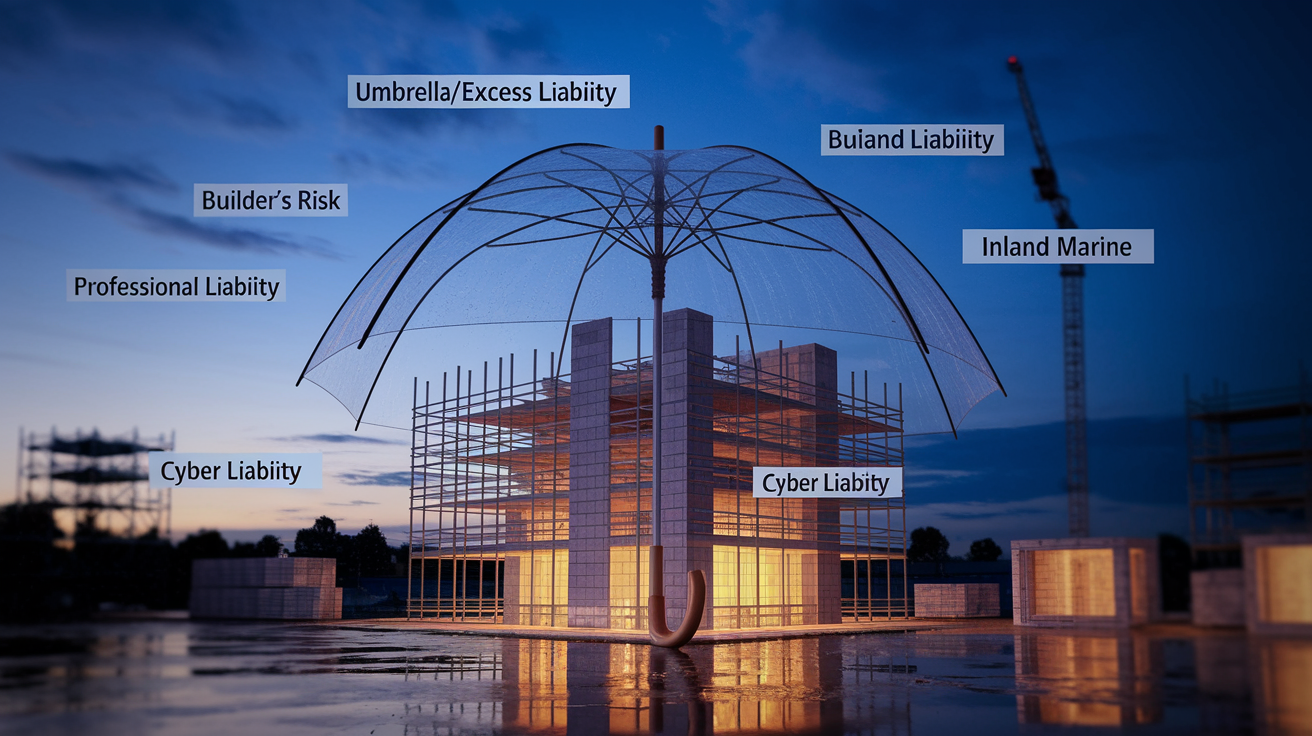
State mandated minimums get you licensed. But they don’t cover the full range of risks that show up in construction contracts or protect you from catastrophic loss.
Umbrella or excess liability policies add $1 million to $5 million in additional limits above your underlying general liability, commercial auto, and employer’s liability coverage. They kick in after your primary policy limits are exhausted. That happens faster than you’d expect on serious claims involving permanent injuries, multiple victims, or extensive property damage. Many commercial clients and government contracts require umbrella coverage before you can bid, especially on projects valued above $1 million or public works jobs where taxpayer funds are involved.
Builder’s risk insurance covers the building under construction. Materials, fixtures, and installed equipment from the start of work until the project is complete and the certificate of occupancy is issued. It protects against fire, wind, hail, theft, vandalism, and collapse during construction. Lenders almost always require it on financed projects. Savvy property owners demand it on larger remodels or new builds where the project value exceeds what your general liability would cover for property damage. The policy is usually written for the full replacement value of the structure and can include soft costs like permit fees and design fees if the project has to be rebuilt after a covered loss.
Professional liability, also called errors and omissions insurance, covers financial losses resulting from mistakes in design, planning, project management, or professional advice. If you’re doing design build work, construction management, or any role where you’re responsible for drawings, specifications, or engineering decisions, this coverage protects you when a design flaw leads to structural problems, code violations, or cost overruns. It’s claims made coverage, so you need continuous renewal or tail coverage to stay protected after switching carriers.
Other supplementary coverages that often come up in contracts or risk assessments:
Tools and equipment insurance. Covers theft or damage to owned tools, power equipment, and safety gear in transit, storage, or on site.
Pollution liability. Covers cleanup costs, legal defense, and damages from mold, asbestos, lead paint, fuel spills, or chemical exposure.
Commercial property. Covers buildings you own or lease, office contents, and business personal property.
Installation floater. Covers materials and equipment you’ve installed but not yet been paid for.
Inland marine. Broader coverage for tools, materials, and equipment in transit or temporary storage.
Cyber liability. Covers data breaches, ransomware, and loss of customer information stored digitally.
Project complexity and contract value drive additional coverage needs more than anything else. A $30,000 bathroom remodel might only require GL and workers’ comp. But a $2 million commercial tenant improvement will trigger requirements for umbrella, builder’s risk, professional liability, and pollution coverage because the financial exposure and contract language demand it.
Subcontractor Insurance Obligations and Additional Insured Requirements

When you hire subcontractors, their insurance becomes your business. Their uninsured liability becomes your liability if they don’t carry adequate coverage.
Subcontractors must carry their own general liability, workers’ compensation, commercial auto, and tools and equipment insurance at limits that match or exceed what you’re required to carry as the general contractor. Minimum acceptable limits are typically $1 million per occurrence and $2 million aggregate for general liability, statutory workers’ comp for all employees, and state minimum auto liability for any vehicles used on the project. If a subcontractor’s coverage is lower than yours, their inadequate limits expose you to claims that exceed what their policy will pay.
Additional insured endorsements and waiver of subrogation clauses shift financial responsibility back to the subcontractor’s insurer where it belongs. An additional insured endorsement on the subcontractor’s general liability policy names you as a covered party for claims arising from the subcontractor’s work. Their carrier defends and pays claims instead of yours. A waiver of subrogation prevents the subcontractor’s insurer from suing you to recover costs they paid on a claim, which happens when incidents involve shared fault or overlapping responsibilities on site.
What to verify on every subcontractor certificate of insurance before they start work:
Policy types. General liability, workers’ comp, commercial auto at minimum.
Effective dates. Coverage must span the entire contract period with no gaps.
Limits. Per occurrence, aggregate, and auto liability must meet contract requirements.
Additional insured status. Your business and the property owner listed as additional insureds on GL policy.
Primary and non contributory wording. Subcontractor’s policy pays first, before yours is triggered.
Hiring uninsured subcontractors or accepting expired certificates puts your business on the hook for their injuries, liability claims, and property damage. If an uninsured subcontractor’s employee gets hurt on your job site, your workers’ comp carrier may deny the claim and your general liability insurer will treat the injured worker as a third party. That exhausts your policy limits and potentially triggers personal liability if damages exceed coverage.
Certificate of Insurance Requirements for Bidding and Contract Compliance

Certificates of insurance are summary documents proving you hold active coverage that meets licensing board standards and contract insurance requirements.
A certificate of insurance must contain the insurer’s name and contact information, policy numbers for each coverage type, effective and expiration dates, coverage limits broken out by per occurrence and aggregate, the named insured (your business legal name and address), the certificate holder (licensing board, property owner, or project manager), any additional insureds, and a project description if the certificate is job specific. Certificates are issued by your insurance agent or carrier and are typically valid for the duration of the policy period or the contract term, whichever is shorter.
Bidding and contract submission requirements specify the insurance coverage you must carry to be eligible for the project. Typical contractual insurance requirements include $1 million per occurrence and $2 million aggregate general liability, statutory workers’ compensation with employer’s liability limits of at least $500,000/$500,000/$500,000, commercial auto liability matching state minimums or higher, additional insured endorsements for the property owner and general contractor, and primary and non contributory wording so your policy responds before the project owner’s coverage. Larger contracts add umbrella requirements of $1 to $5 million, builder’s risk naming the lender and owner as loss payees, and professional liability if design or consulting services are included.
Project specific mandates for federal, state, and municipal contracts include Davis Bacon prevailing wage compliance documentation, certified payroll reporting tied to workers’ comp audits, payment and performance bonds naming the contracting agency as obligee, and certificates listing the government entity as both certificate holder and additional insured. Federal contracts often require cyber liability and rigorous subcontractor insurance verification with flow down requirements ensuring every tier of subs meets the same minimums.
Steps for obtaining and managing certificates of insurance:
Contact your insurance agent or carrier as soon as you have contract language or a bid invitation.
Specify the certificate holder’s legal name and mailing address exactly as listed in the contract.
Request necessary endorsements in writing, including additional insured status and waivers of subrogation.
Verify accuracy before submission, especially policy numbers, limits, and additional insured wording.
Track expiration dates and request renewal certificates 30 days before coverage lapses.
| Project Type | Typical Certificate Requirements | Special Documentation |
|---|---|---|
| Residential Remodel | GL $1M/$2M, Workers’ Comp, Auto Liability | Homeowner named as additional insured, certificate holder |
| Commercial Construction | GL $1M/$2M, WC, Auto, Umbrella $1–2M, Builder’s Risk | Property owner and lender as additional insureds and loss payees |
| Municipal Public Works | GL $2M/$4M, WC, Auto, Umbrella $5M, Payment/Performance Bonds | City or county named as certificate holder, 30-day cancellation notice required |
| Federal Government Contracts | GL $1M/$2M, WC, Auto, Umbrella $2–10M, Cyber Liability, Bonds | Contracting agency as certificate holder and additional insured, GSA Schedule compliance if applicable |
Coverage lapses during active projects trigger stop work orders, contract defaults, and potential liability for delays or damages occurring while uninsured. Contract language almost always includes a clause requiring continuous coverage with 30 days’ written notice before cancellation. Project owners monitor certificate expiration dates to enforce compliance.
Bonding Requirements and Financial Responsibility Standards

Surety bonds guarantee performance or payment to project owners and suppliers. But they’re not insurance policies and they don’t protect your business.
License bonds are required for contractor licensing in many states as proof of financial responsibility and consumer protection. The bond guarantees that you’ll comply with state contractor laws, pay suppliers and subcontractors, and remedy defective work or code violations. Bond amounts typically range from $5,000 to $50,000 depending on the state and contractor classification. If a homeowner or supplier files a valid claim against your bond, the surety pays the claim and then comes after you to recover the full amount plus fees and interest.
Bid bonds and performance bonds are required for public works projects and many large commercial contracts. A bid bond, usually 5 to 10% of the bid amount, guarantees that if you win the bid you’ll sign the contract and provide the required performance and payment bonds. A performance bond, typically 100% of the contract value, guarantees that you’ll complete the project according to plans and specifications. If you abandon the job or fail to perform, the surety hires another contractor to finish the work and charges you for the cost overruns.
Payment bonds protect subcontractors, suppliers, and laborers by guaranteeing they’ll be paid even if you default or go out of business. Payment bonds are almost always required alongside performance bonds on public projects and are increasingly common on large private commercial work. The bond amount matches the contract value. Claimants file directly against the bond instead of placing mechanic’s liens on public property.
How bonds differ from insurance:
Who they protect. Bonds protect project owners and third parties. Insurance protects your business.
Claims process. Bond claims result in full reimbursement demands against you. Insurance pays on your behalf.
Premium versus bond cost structure. Bond premiums are based on contract value and your credit. Insurance premiums are based on revenue, payroll, and loss history.
Annual renewal. Bonds are project specific or license specific. Insurance renews annually regardless of active projects.
Bond requirements interact with insurance minimums on large projects by establishing a total financial responsibility threshold. That combines bonding capacity and insurance limits to prove you can handle the contract value and risk exposure without defaulting.
Penalties, Licensing Consequences, and Compliance Verification
Insurance compliance is actively monitored by licensing boards, contract administrators, and workers’ compensation regulators who cross check data and flag discrepancies.
Licensing penalties for failing to maintain required insurance include immediate suspension of your contractor license, revocation requiring reapplication and re examination, fines ranging from $500 to $10,000 depending on the violation and state, and prohibition from renewing your license until you provide proof of continuous coverage for the required period. Some states impose escalating penalties for repeat violations. A few treat operating without required insurance as a misdemeanor with potential jail time for willful non compliance.
Contract level consequences hit faster and cost more than licensing penalties. If your coverage lapses or limits drop below contract requirements during an active project, the property owner or general contractor can issue a stop work order requiring you to leave the site until compliant coverage is reinstated. Contract termination for insurance non compliance allows the owner to hire a replacement contractor and backcharge you for cost overruns, schedule delays, and re mobilization expenses. Payment withholding clauses let owners hold retainage and progress payments until you provide proof of compliant coverage. You may be held liable for damages or injuries occurring during any coverage gap.
Methods authorities use to verify insurance compliance:
Certificate of insurance audits. Licensing boards and contract administrators request updated certificates quarterly or upon renewal.
Direct carrier verification. Boards contact insurers to confirm active coverage and policy details match submitted certificates.
Licensing board databases. Some states maintain centralized insurance databases where carriers report policy changes and cancellations in real time.
Workers’ comp audit cross checks. State workers’ comp boards share data with contractor licensing boards to flag discrepancies in employee counts and coverage status.
Maintaining continuous coverage and avoiding policy lapses requires tracking renewal dates 60 to 90 days in advance, paying premiums on time or enrolling in automatic payment plans, notifying your agent immediately if your business changes in ways that affect coverage, and requesting updated certificates whenever policy terms or limits change midterm.
Cost Factors, Premium Calculation, and Obtaining Affordable Coverage

Insurance premiums vary widely based on your trade classification, annual revenue, payroll, claims history, and the coverage limits you carry.
Insurers evaluate several factors to calculate risk and set premiums. Business classification codes (like GL codes and NCCI workers’ comp class codes) group contractors by trade and assign base rates reflecting industry loss history. Residential framers and roofers pay more than finish carpenters and tile setters because injury and liability claim frequency is higher. Years in business and ownership stability matter because new contractors and frequent ownership changes correlate with higher claim rates. Loss runs showing your claims history for the past five years directly impact your premium, with even one large claim increasing costs by 20 to 40% at renewal. Safety programs, documented training, and written policies reduce premiums by 5 to 15% with most carriers.
Typical premium ranges vary by contractor type and coverage limits. General liability for a small remodeling contractor with $300,000 annual revenue might cost $800 to $1,500 per year for $1 million/$2 million limits. A general contractor doing $2 million in commercial work could pay $3,000 to $6,000 or more. Workers’ compensation is calculated as a percentage of payroll by employee classification, ranging from 5 to 10% for office staff and light duty trades to 30 to 50% for roofing, demolition, and structural steel work. A framing crew with $200,000 in annual payroll might generate $30,000 to $50,000 in workers’ comp premium depending on the state and loss history.
Strategies for reducing insurance costs without sacrificing necessary protection include bundling general liability, commercial property, auto, and umbrella policies with one carrier for multi policy discounts of 10 to 20%, implementing documented loss control programs like weekly toolbox talks and incident reporting to qualify for safety credits, choosing higher deductibles on general liability and auto coverage to lower premiums if you have cash reserves to cover small claims, and shopping multiple carriers every 2 to 3 years because pricing and underwriting appetite shift as carriers enter and exit the construction market.
Information needed to obtain accurate insurance quotes:
Detailed business description including trades performed, typical project types, and whether you self perform or subcontract work.
Annual revenue for the past year and projected revenue for the upcoming year.
Payroll broken out by employee classification (office, carpentry, roofing, electrical, etc.).
Prior coverage limits and carrier names for the past 3 to 5 years.
Loss history showing claims, reserves, and payments for the past 5 years.
Working with specialized construction insurance brokers produces better results than using standard commercial agents. Construction focused brokers maintain relationships with carriers that actively write contractor coverage, understand trade specific risks and how to present your business favorably, and know which carriers offer the most competitive rates for your classification and loss profile.
Final Words
Meeting contractor insurance minimum coverage requirements isn’t optional—it’s the entry ticket to licensing, bidding, and staying in business legally.
Every state structures its mandates differently, and your local jurisdiction might layer on even tighter rules. Start by confirming your state’s baseline requirements, then verify what your clients and contracts actually demand before you submit your first certificate.
Check your coverage limits against project values, not just state minimums. Keep your certificates current, your subcontractors verified, and your bonding squared away.
When your insurance matches the work you do, you protect your license, your contracts, and your ability to keep building without interruption.
FAQ
Q: What is the 80% rule in insurance?
A: The 80% rule in insurance is a coinsurance clause requiring property coverage of at least 80% of replacement value to avoid penalties. If you underinsure and file a claim, the insurer reduces payout proportionally. This rule applies to commercial property policies, not general liability or workers’ compensation coverage contractors typically carry.
Q: What are typical insurance requirements in a contract?
A: Typical insurance requirements in a contract include general liability coverage of $1 million per occurrence and $2 million aggregate, commercial auto liability, workers’ compensation at statutory limits, and naming the property owner or general contractor as additional insured. Contracts may also require umbrella coverage, builder’s risk insurance, and waiver of subrogation endorsements.
Q: How much is $1,000,000 general liability?
A: A $1,000,000 general liability policy typically costs contractors between $500 and $5,000 annually, depending on trade classification, payroll, revenue, claims history, and location. Low-risk trades like finish carpentry pay less, while high-risk trades like roofing or demolition pay significantly more. Most policies include $2 million aggregate limits with the $1 million per occurrence coverage.
Q: What is the minimum insurance cover you must have?
A: The minimum insurance cover you must have depends on your state licensing requirements and whether you have employees. Most states require general liability coverage ranging from $200,000 to $500,000 per occurrence for contractor licensing. Workers’ compensation is mandatory in nearly all states if you have employees, regardless of your trade or business size.
Q: Do all states require contractors to carry insurance?
A: All states do not require contractors to carry general liability insurance for licensing, though most do. States like Texas, Kansas, and Kentucky have no statewide general liability mandate, but local jurisdictions often require coverage for permits. Workers’ compensation is mandatory in most states for businesses with employees, even sole proprietors in some cases.
Q: What coverage limits do Washington state contractors need?
A: Washington state contractors need minimum $200,000 public liability and $50,000 property damage or $250,000 combined single limit for licensing. General contractors must also post a $30,000 surety bond and list the Department of Labor & Industries as certificate holder. These are baseline requirements; contracts typically demand higher limits.
Q: What is the difference between per occurrence and aggregate limits?
A: The difference between per occurrence and aggregate limits is that per occurrence covers a single claim or incident, while aggregate is the maximum the policy pays for all claims during the policy period. A typical structure is $1 million per occurrence with $2 million general aggregate, meaning one claim maxes at $1 million but total annual claims cap at $2 million.
Q: Why do general contractors require subcontractors to carry insurance?
A: General contractors require subcontractors to carry insurance to avoid liability for subcontractor-caused injuries or property damage. If a subcontractor lacks coverage, the general contractor’s policy may be forced to respond, increasing claims history and future premiums. Requiring certificates of insurance with additional insured endorsements transfers risk back to the subcontractor’s carrier.
Q: What is an additional insured endorsement?
A: An additional insured endorsement extends liability coverage to another party, typically a property owner or general contractor, for claims arising from the named insured’s work. General contractors require this endorsement from subcontractors so the subcontractor’s insurance responds first to job-related claims. Primary and non-contributory wording ensures the subcontractor’s policy pays before the general contractor’s coverage applies.
Q: How long does a certificate of insurance remain valid?
A: A certificate of insurance remains valid only while the underlying policy is active and typically matches the policy period, usually one year. Certificates do not extend coverage and become void immediately if the policy cancels or lapses. Contract administrators and licensing boards require updated certificates when policies renew to maintain compliance throughout project duration.
Q: What is a surety bond and how does it differ from insurance?
A: A surety bond is a financial guarantee that the contractor will fulfill licensing or contract obligations, protecting the public or project owner. Unlike insurance, which protects the policyholder from claims, a bond protects third parties, and the contractor must reimburse the surety for any payments. License bonds typically range from $5,000 to $50,000 depending on state requirements.
Q: What happens if you work without required insurance coverage?
A: Working without required insurance coverage can result in license suspension or revocation, fines, inability to bid on projects, contract termination, and personal liability for all damages. Licensing boards actively verify coverage through certificate audits and direct carrier confirmation. If an uninsured contractor causes injury or property damage, personal assets become exposed to lawsuits.
Q: How do contractors reduce insurance premium costs?
A: Contractors reduce insurance premium costs by bundling policies with one carrier, maintaining clean loss history, implementing documented safety programs, choosing higher deductibles, and shopping multiple specialized construction insurers. Accurate payroll reporting by employee classification and joining trade association group programs also lower premiums. Working with construction-focused insurance brokers typically yields better rates than standard commercial agents.