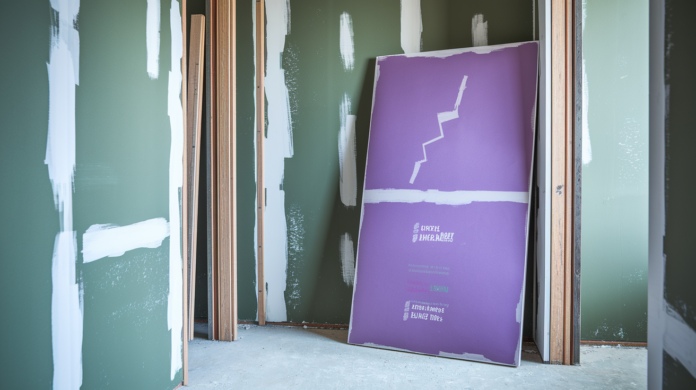

You’ve probably heard purple drywall costs more and figured it’s just another upsell. But here’s what contractors know: purple mold resistant drywall actually prevents the kind of moisture damage that forces you to rip out entire bathroom walls two years after installation. This isn’t about fancy colors or marketing gimmicks. It’s about antimicrobial technology built into both the gypsum core and recycled paper facing that stops mold growth where greenboard and standard drywall fail. If you’re working in bathrooms, basements, or anywhere moisture shows up regularly, understanding what purple board does differently and where it’s worth the premium can save you from doing the same repair twice.
What is Purple Mold Resistant Drywall and Should You Use It?
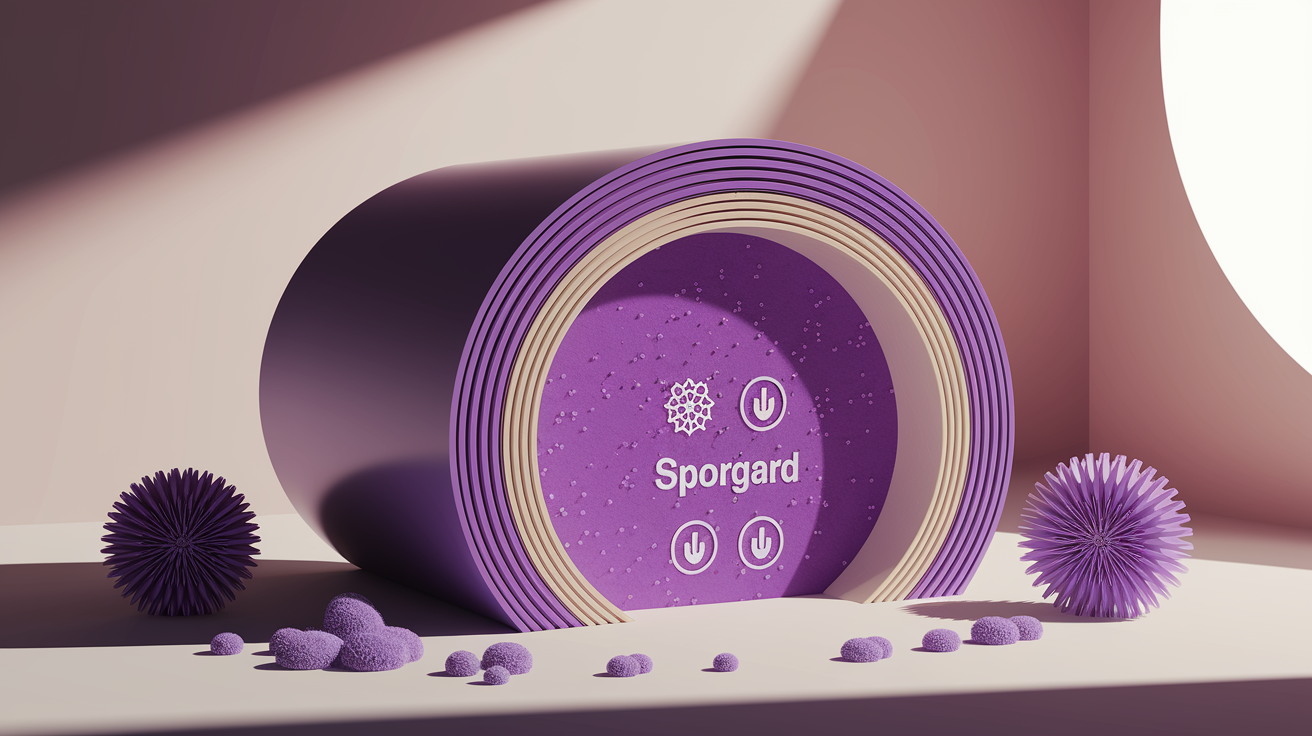
Purple mold resistant drywall is a branded moisture and mold resistant gypsum board made exclusively by National Gypsum’s Gold Bond Building Products division. The product launched as PURPLE XP back in 2003, and it’s got SPORGARD antimicrobial technology built right into both the paper facing and the gypsum core. SPORGARD started out as a food preservative before somebody figured out it could work in building materials to fight off mold and mildew. The purple face paper comes from 100 percent recycled content that’s been engineered for mold, mildew, and moisture resistance, not just dipped in purple dye.
Purple board beats traditional greenboard in one way that actually matters. Greenboard only resists moisture, while purple board resists both moisture and mold.
When you’re comparing options, purple board scores highest on both ASTM D3273 and ASTM G21 mold testing standards. Water absorption tests show less than 5 percent, which beats most moisture resistant alternatives. The antimicrobial protection runs through the entire paper facing layer and core, not just some surface treatment that wears off when you’re cutting panels or banging them into tight corners. This comes up when you’re dealing with minor water exposure during construction.
Greenboard was the default moisture resistant option for decades before purple board showed up, and it still works as a lower cost alternative for areas with moderate humidity.
Five key factors to consider when choosing purple board over alternatives:
- Primary applications match your project: Bathrooms, basements with humidity problems, kitchens near sinks, laundry rooms, anywhere persistent moisture creates mold risk
- Cost benefit math: Purple board costs 20 to 30% more than greenboard but prevents mold damage that ends with tear out and replacement
- Mold resistance versus moisture resistance only: Greenboard slows water penetration but doesn’t stop mold growth once moisture gets through
- Long term performance value: Active antimicrobial protection keeps working for the life of the installation, not just until first water exposure
- When standard drywall is sufficient: Dry living areas, bedrooms, spaces with normal HVAC control don’t need specialty boards
Purple board typically costs $15 to $20 per 4×8 sheet compared to $10 to $13 for greenboard and $8 to $10 for standard drywall. That premium buys you protection worth having in bathrooms behind sinks and around toilets where splashing happens daily, basement walls where groundwater and seasonal humidity create persistent dampness, kitchens near dishwashers and prep sinks, and laundry rooms with dryer exhaust and washer connections. The product also resists dents and scratches better than standard drywall, which helps in high traffic bathrooms and utility areas where you’re moving tools, ladders, or storage items.
One thing that matters when you’re shopping: “purple” specifically refers to National Gypsum’s trademarked color and product line, registered with the U.S. Trademark Office in 2012. Other manufacturers like Georgia Pacific and USG make similar mold resistant gypsum boards with antimicrobial technology, but they use different colors and branding.
Wet Area Applications: Where to Install Purple Mold Resistant Drywall
Purple board works in any room, but the cost premium only makes sense where moisture and humidity create real mold risk.
Bathrooms are the main target. Install purple board behind sinks where toothbrushing and handwashing create daily splashing, around toilets where condensation forms on tanks in humid weather, and above tile in tub and shower areas. The PURPLE eXP Tile Backer variant is approved as a code compliant substrate for high moisture areas, which means you can use it as the base layer in shower surrounds, full bathrooms, and even indoor pool enclosures. This code compliance matters during inspection. It’s not just manufacturer marketing, it’s tested and certified for wet area use.
Basement walls face different moisture challenges than bathrooms but need the same mold resistance. Groundwater creates persistent dampness through concrete, seasonal humidity swings bring condensation, and below grade spaces naturally hold moisture longer than upper floors. Greenboard specifically should not be used on water prone basement walls, which is called out in product limitations. Purple board’s ASTM D3273 and ASTM G21 test scores prove it handles this chronic low level moisture without supporting mold growth. If your basement floods regularly or has active water intrusion, no drywall works. You need to fix drainage first.
Kitchens and laundry rooms are secondary applications where purple board prevents problems without being strictly necessary. Install it near kitchen sinks, behind dishwashers where supply line leaks go unnoticed, and around any prep sink or wet bar. In laundry rooms, use it near washer connections, around utility sinks, and on walls that take dryer exhaust condensation. These areas don’t get soaked like showers, but they see enough moisture over time to make standard drywall a risk.
The tile backer board approval is specific. Purple board works in dry areas and limited water exposure areas with ASTM D3273 and ASTM G21 compliance, which covers toilet and sink areas, above tile sections in tubs and showers, and full bathroom installations when detailed correctly. It’s approved for showers, bathrooms, indoor pools, and kitchens as a code compliant substrate. This puts it between greenboard and cement board in the wet area spectrum.
Installation Best Practices for Purple Mold Resistant Drywall
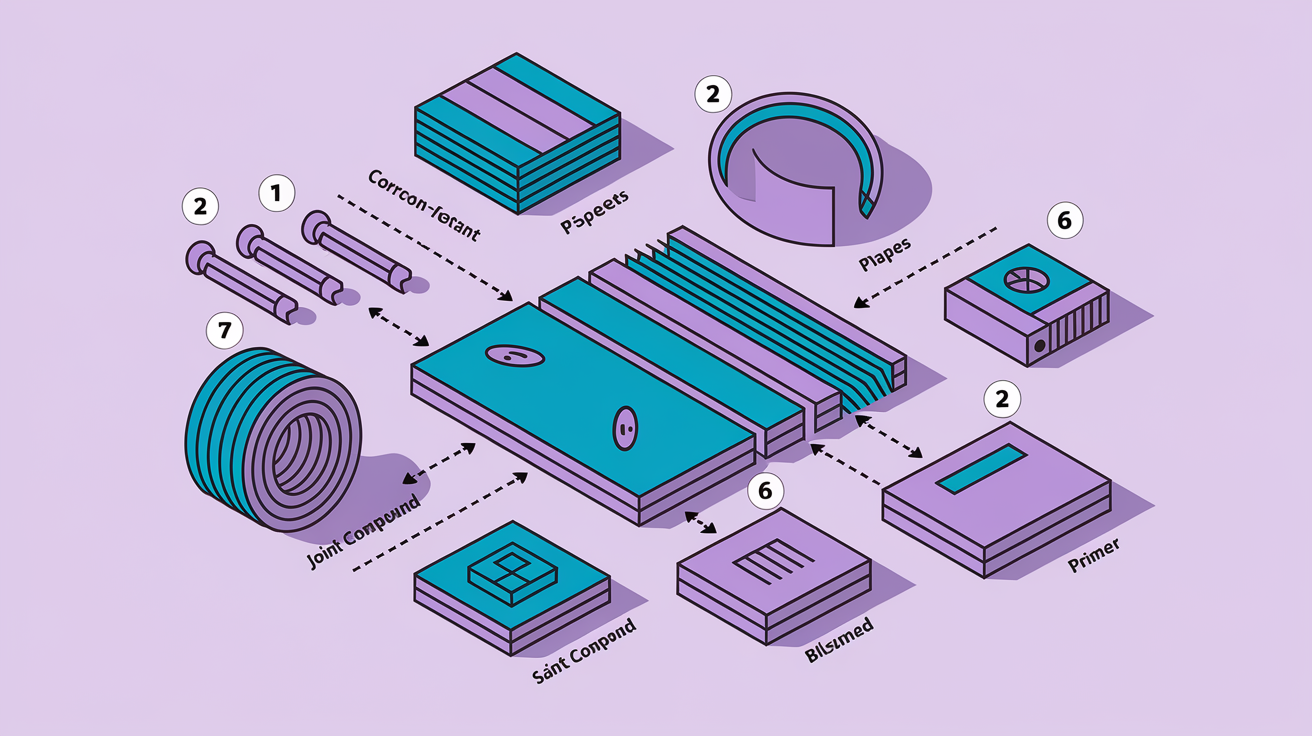
Purple board installs just like standard drywall. It attaches directly to studs with screws, cuts with a sharp utility knife, and finishes with standard joint compound.
National Gypsum prints GridMarX installation guide marks on each board to help with accurate placement and faster layout. These alignment marks reduce measuring mistakes and help maintain consistent screw spacing. The company also offers a PURPLE materials calculator that estimates room by room quantities for residential projects, which prevents the “one sheet short” problem that kills momentum on installation day.
Six step installation and finishing sequence for purple mold resistant drywall:
-
Measure and cut panels using a sharp utility knife and straightedge. Score the purple paper facing, snap the gypsum core, then cut through the back paper. Panel edges should land on stud centers.
-
Install panels with corrosion resistant screws spaced 12 inches on center on walls, 12 inches on ceilings. Drive screws deep enough to dimple the paper without breaking through. Start at the center of each panel and work toward edges.
-
Tape joints with paper tape or fiberglass mesh tape depending on joint type. Inside corners take paper tape folded down the center. Butt joints need mesh tape or paper tape with proper bedding compound underneath.
-
Apply joint compound over the recycled purple paper surface in three coats: taping coat, second coat, and finish coat. Purple board accepts standard joint compound without special additives or modified formulas.
-
Sand between coats with 120 grit paper after each coat fully dries. Check drying with a moisture meter in humid spaces. Compound that looks dry can still be damp inside, which leads to raised joints later.
-
Prime and paint with moisture resistant primer in wet areas. Standard latex primer works in dry areas. Purple board accepts paint and texture just like regular drywall once primed.
Corrosion resistant screws matter in wet areas because standard drywall screws rust through when exposed to bathroom humidity and create brown stains that bleed through paint. Space screws correctly. Too few screws let panels sag under moisture weight, too many screws create extra holes that compromise the moisture barrier. Seal around all penetrations for plumbing, electrical boxes, and exhaust fans with appropriate caulk or foam. The mold resistant technology works in the gypsum and paper, but gaps around pipes let moisture reach the stud cavity where mold grows unchecked.
Purple board accepts standard joint compound and finishing techniques without modification. The recycled purple paper surface has the same texture and absorption rate as standard drywall paper. Some installers worry the purple color will show through paint, but it doesn’t. Primer covers it completely. In moisture prone areas, choose primer with mildewcide additives to maintain the mold resistant properties through the finish coat. Skip the mildewcide primer in dry areas where it’s not needed.
Professional installation makes sense for shower surrounds, fire rated assemblies, and any application where building code requires specific detailing or inspection. Fire rated walls need exact fastener patterns and joint treatment to maintain the rating. Shower surrounds require proper membrane integration, which most DIYers get wrong. DIY installation works fine for bathroom walls behind sinks and toilets, basement walls, and kitchen backsplash areas where code requirements are straightforward and mistakes don’t create water damage risk. Proper installation directly impacts mold resistance performance. The technology in the board works, but only if joints are sealed, penetrations are caulked, and the moisture barrier stays intact. Installation mistakes can void warranty coverage.
Product Specifications and Panel Thickness Options for Purple Drywall
Standard purple board comes in 1/2 inch and 5/8 inch panel thicknesses for different structural and performance requirements. The 1/2 inch thickness works for most residential wall applications over 16 inch on center framing. The 5/8 inch panels provide increased dimensional stability, better sag resistance on ceilings, and improved fire ratings in assemblies where that matters. Both thicknesses maintain the same mold resistance properties. The antimicrobial technology runs through the entire core regardless of panel depth.
The gypsum core composition uses the same calcium sulfate base as standard drywall, reformulated to achieve less than 5 percent water absorption in ASTM testing. Face paper is manufactured from 100 percent recycled purple paper engineered for moisture, mold, and mildew resistance. Some product variants feature fiberglass coated facers for increased durability and extended weather exposure during construction. All purple board products use tapered edges on the long sides to accommodate joint compound without creating raised seams. Short edges are square cut, which is standard for gypsum board.
Purple board meets UL Classification requirements for fire resistance and surface burning characteristics, which means it performs like standard Type X drywall in fire rated assemblies when installed correctly. The 5/8 inch eXP Tile Backer is available with Fire Shield Type X rating for assemblies requiring 1 hour or 2 hour fire resistance. All three XP variants (standard, Hi Abuse, Hi Impact) meet fire resistance ratings and can substitute for standard drywall in non rated walls and for Type X in rated assemblies depending on thickness and specific product designation. Fire ratings depend on complete assembly details, not just board specification. You need proper fastener spacing, joint treatment, and installation per tested assembly instructions.
| Panel Thickness | Fire Rating | Typical Application |
|---|---|---|
| 1/2 inch standard | Standard fire resistance | Residential walls, non rated partitions, 16 inch on center framing |
| 5/8 inch standard | Standard fire resistance | Ceilings, commercial walls, improved sag resistance, 24 inch on center framing |
| 5/8 inch Type X | 1 hour to 4 hour depending on assembly | Fire rated walls, shaft walls, area separation walls, tile backer in rated assemblies |
PURPLE Product Family: Specialized Mold Resistant Drywall Variants
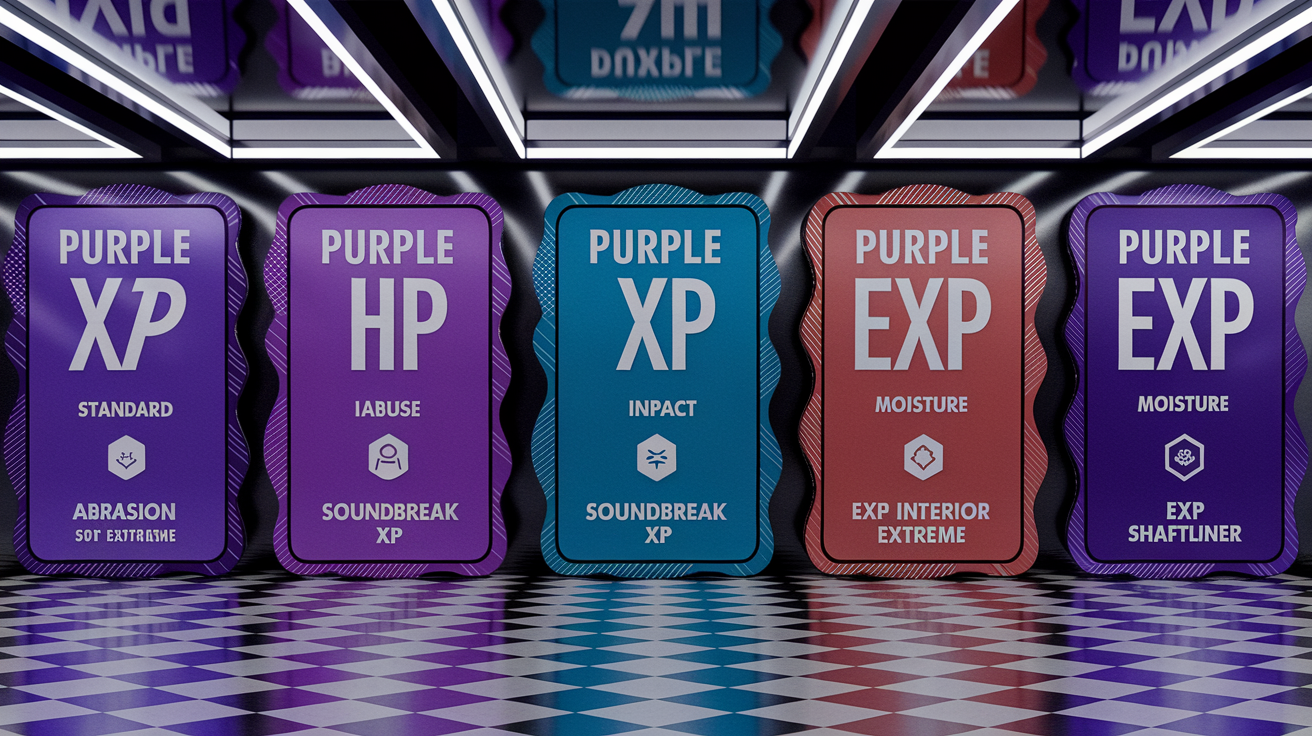
National Gypsum developed the PURPLE product line over 20 years with ongoing additions for specialized performance requirements beyond basic mold resistance. The product family now includes options for abuse resistance, impact protection, sound control, extreme durability, and fire rated shaft construction.
Each variant maintains the core SPORGARD antimicrobial technology and moisture resistance, then adds specific features for different building challenges.
PURPLE XP Standard, Hi Abuse, and Hi Impact Variants
PURPLE XP is the baseline product with mold resistance, moisture resistance, and mildew resistance integrated into both paper facing and gypsum core. This is the standard choice for bathrooms, basements, and kitchens where moisture control and mold prevention are the primary concerns.
PURPLE XP Hi Abuse adds heavy abrasion resistant face paper and a specially formulated gypsum core for high traffic areas where wall surfaces take repeated contact. Install this variant in commercial restrooms, school bathrooms, hotel corridors, and residential mudrooms where bags, equipment, and foot traffic create daily wall contact. The abrasion resistance prevents the surface damage that exposes raw gypsum and compromises moisture protection.
PURPLE XP Hi Impact includes fiberglass mesh embedded in the core for areas prone to cavity penetration. Doorways that take doorknob strikes, narrow hallways where furniture and equipment get moved, utility rooms with hand trucks and appliances, and garage entries where you’re hauling tools and supplies. The fiberglass mesh holds the core together under impact that would shatter standard drywall.
SoundBreak XP Acoustic Products
SoundBreak XP products feature two high density gypsum boards laminated together with a sound damping viscoelastic polymer layer between them. This construction dampens sound transmission through walls and ceilings without requiring separate resilient channel or multiple layers of standard drywall. The mold resistant purple facing is maintained on the exposed surface.
SoundBreak XP Wall Board works for party walls between apartments or condos, walls between bedrooms and bathrooms, home theater walls, and any partition where sound isolation matters. SoundBreak XP Ceiling Board addresses impact noise from footsteps on the floor above and airborne noise from voices and electronics. One layer of SoundBreak XP performs like two layers of standard drywall with resilient channel, which saves labor and maintains ceiling height.
SoundBreak XP Retrofit allows acoustical improvement of existing walls without demolition. This variant is thin enough to install directly over existing drywall, which matters in rental properties, condos with noise complaints, and homes where you can’t gut walls. The retrofit option brings sound control to finished spaces without the dust, debris, and displacement of full renovation.
eXP Interior Extreme and Shaftliner Options
eXP Interior Extreme panels feature fiberglass coated facers on both sides with a 12 month exposure warranty, which means you can leave them exposed to weather during construction without performance degradation. This matters on projects with extended build schedules, buildings that dry in slowly, and renovation work where one section is open while others remain occupied. The fiberglass facing is paperless, which eliminates the organic material that mold needs to grow even when the board gets wet during construction.
eXP Interior Extreme AR (Abrasion Resistant) provides increased indentation and abrasion resistance through a denser gypsum core formulation. Use this variant in high traffic commercial applications, institutional buildings like schools and hospitals, and industrial spaces where wall contact is frequent and forceful. The AR designation indicates it handles more abuse than standard Hi Abuse purple board.
eXP Interior Extreme IR (Impact Resistant) includes fiberglass mesh embedded in the core like Hi Impact purple board, but combines that with the paperless fiberglass facing for maximum durability. This is the most abuse tolerant option in the product line.
eXP Shaftliner is available with Type X fire resistant gypsum core and moisture resistant purple paper on all four sides, both faces and both edges. This construction allows installation in shaft walls, chase walls, and stairwell enclosures requiring 1 hour to 4 hour fire barriers. The all sides purple paper protection matters in shaft applications where both sides of the wall see high humidity from plumbing or HVAC equipment. Standard shaftliner only protects one face, which leaves the cavity side vulnerable to moisture and mold in mechanical shafts.
Cost Comparison and Price Considerations for Purple Board Drywall
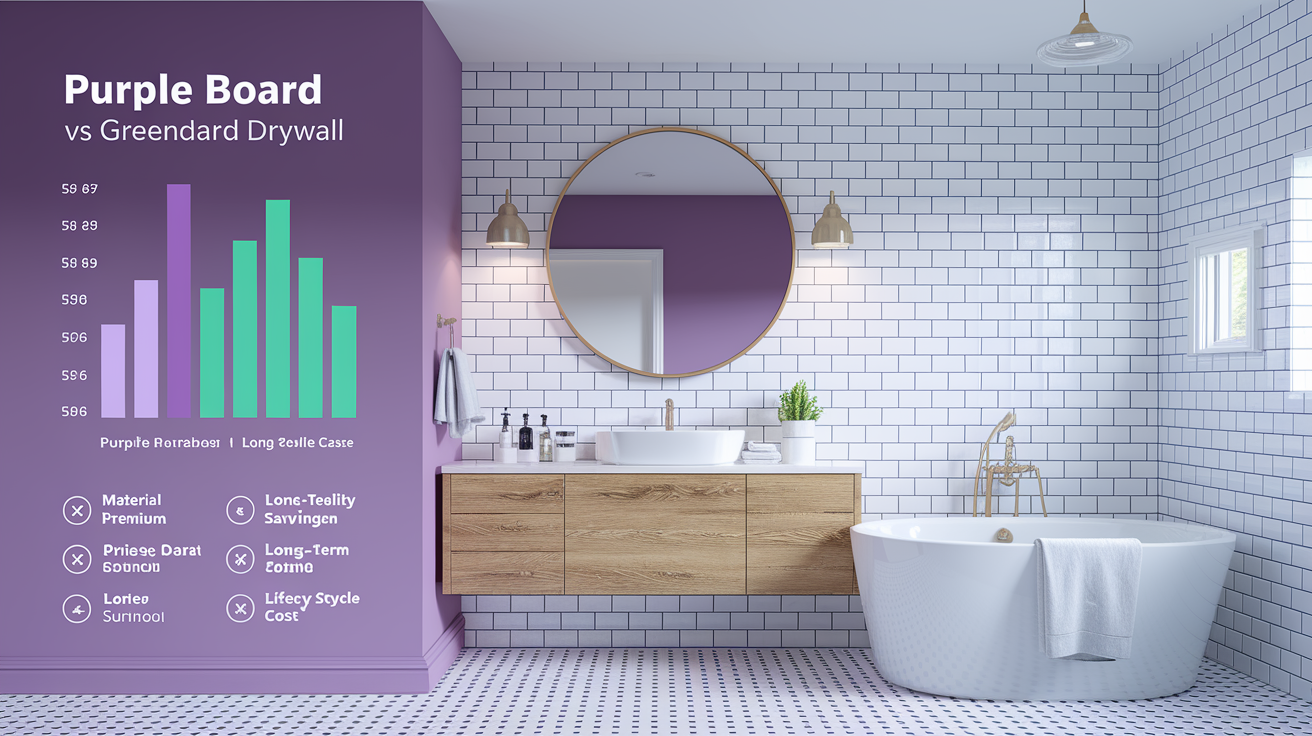
Purple board typically costs $15 to $20 per 4×8 sheet compared to $10 to $13 for greenboard and $8 to $10 for standard 1/2 inch drywall. That’s a 25 to 50% premium over greenboard and roughly double the cost of standard drywall. A typical bathroom with 400 square feet of wall area needs about 13 sheets, which means purple board costs an extra $65 to $130 over greenboard and $90 to $155 over standard drywall for material alone.
Purple board functions as a cement board alternative in limited water exposure applications, which is where the cost advantage becomes clear. Cement board costs $18 to $28 per 3×5 sheet and requires special cutting tools, carbide scoring knives, and more installation labor. A 4×8 purple board covers 32 square feet while a 3×5 cement board covers 15 square feet, and you can cut purple board with a standard utility knife. For walls around toilets, behind bathroom sinks, and above tile in tub surrounds, purple board handles the moisture exposure with easier installation and lower total cost. Cement board is still necessary for shower floors, direct shower spray zones, and anywhere tile is the only barrier between water and wall structure.
The long term value proposition shifts the cost analysis. Purple board’s 12 month exposure warranty on eXP Interior Extreme variants protects against construction delays and weather exposure that would ruin standard drywall. The SPORGARD antimicrobial technology continues working for the life of the installation. There’s no degradation or depletion over time. Standard drywall in a bathroom often fails within 10 to 15 years from repeated moisture exposure, which means tear out, disposal, and full replacement. Purple board’s moisture resistance and mold prevention extend service life, which converts the upfront premium into lifecycle savings when you avoid premature replacement. Mold damage typically costs $2,000 to $6,000 for bathroom remediation, which makes the $100 to $150 material premium look like cheap insurance.
Five cost factors that influence total project expense beyond material price:
- Material price premium of 25 to 50% over greenboard requires project by project decision on where specialty boards add value versus where standard drywall suffices
- Labor installation costs remain identical to standard drywall since cutting, hanging, and finishing methods don’t change
- Long term durability savings from extended service life and avoided mold remediation work can exceed 10x the material premium
- Warranty protection on eXP Interior Extreme products reduces risk on complex projects with extended construction schedules
- Moisture damage prevention value protects both the drywall investment and the structure behind it, avoiding costly stud and framing repairs from chronic moisture exposure
Final Words
Purple mold resistant drywall brings moisture and mold protection together in one board, making it the smart choice for bathrooms, basements, and any high-humidity space where you want durability that lasts.
It costs more upfront than greenboard, but the extra protection and longer performance often pay back in fewer repairs and no mold callbacks.
If you’re working in wet areas or dealing with consistent moisture, purple board gives you the right foundation to build on.
FAQ
Is PURPLE drywall mold-resistant?
PURPLE drywall is mold-resistant due to SPORGARD antimicrobial technology integrated into both the paper facing and gypsum core, achieving the highest scores on ASTM D3273 and ASTM G21 mold testing standards with less than 5 percent water absorption.
What type of drywall is mold-resistant?
Mold-resistant drywall includes PURPLE board by National Gypsum, along with similar products from Georgia Pacific and USG, all featuring antimicrobial additives or paper-free compositions. These boards differ from standard greenboard, which offers moisture resistance only without mold protection.
Is it worth it to get mold-resistant drywall?
Mold-resistant drywall is worth the cost premium in bathrooms, basements, and high-humidity areas where moisture creates ongoing mold risk. The investment pays off through reduced replacement needs and prevention of costly mold remediation, though standard drywall works fine in dry interior rooms.
What color is mold-resistant drywall?
Mold-resistant drywall from National Gypsum features trademark purple 100 percent recycled paper facing, while competing manufacturers produce similar products in different colors. The purple color specifically identifies National Gypsum’s Gold Bond Building Products brand, not a universal standard for all mold-resistant boards.
Where should purple mold-resistant drywall be installed in bathrooms?
Purple mold-resistant drywall should be installed in bathrooms behind sinks, around toilets, and above tile in tub and shower areas. The eXP Tile Backer variant is code-compliant for high-moisture areas including shower surrounds when used as a substrate under tile.
Can purple board be used in basements?
Purple board can be used on basement walls where moisture and humidity create mold risk. This contrasts with greenboard, which manufacturers specifically exclude from water-prone basement installations due to insufficient moisture protection.
Is purple drywall approved as tile backer board?
Purple drywall is approved as tile backer board for limited water exposure areas including toilet and sink areas plus above tile in tubs and showers. The eXP Tile Backer variant meets ASTM D3273 and D3271 standards as code-compliant substrate for showers, bathrooms, indoor pools, and kitchens.
Does purple board install differently than regular drywall?
Purple board installs similarly to standard drywall with direct attachment to studs using corrosion-resistant screws. The board includes GridMarX installation guide marks for accurate placement and cuts cleanly with a sharp utility knife like conventional gypsum panels.
What joint compound works with purple drywall?
Purple drywall accepts standard joint compound and finishing techniques used on regular drywall. The recycled purple paper surface takes compound normally, though moisture-prone areas benefit from primer selection that maintains the mold-resistant properties after finishing.
What thickness options are available for purple drywall?
Purple drywall thickness options include standard 1/2-inch and 5/8-inch panels. The 5/8-inch eXP Tile Backer is available with Fire-Shield Type X rating for fire-rated assemblies requiring enhanced fire resistance.
What is PURPLE XP Hi-Abuse drywall used for?
PURPLE XP Hi-Abuse drywall is used in high-traffic areas requiring heavy abrasion resistance. It features abrasion-resistant face paper and specially formulated core beyond standard mold resistance, making it suitable for commercial spaces and hallways with frequent impact.
What is the difference between purple board and cement board?
Purple board functions as a cement board alternative in certain applications with easier installation and lower material cost. While cement board remains required for direct water exposure like shower walls, purple board handles limited water exposure areas at reduced expense and labor difficulty.
How much more does purple drywall cost than greenboard?
Purple drywall costs more per sheet than greenboard due to enhanced mold resistance and SPORGARD antimicrobial technology. Greenboard provides the more affordable option with moisture resistance only, while purple board delivers both moisture and mold protection for long-term performance.
Does purple drywall have a warranty?
Purple drywall eXP Interior Extreme panels feature a 12-month exposure warranty. Proper installation directly impacts mold resistance performance and warranty coverage, making professional installation critical for complex applications like shower surrounds and fire-rated assemblies.